Madwomen in the City

Image

Karen Ball as Emily Dickinson in Emily & Sue: A Love Story in 5 Scenes and 4 Seizures, Fresh Fruit Festival, NYC. Photo by Martha Nell Smith, 7/26/12.

Road trip! The woman known on Roxie’s World  as Goose has spent her career studying the complex, intimate, generative relationship between Emily Dickinson and her sister-in-law Susan Huntington Dickinson. (See, for example, this co-edited collection of letters beloved by Sisters of Sappho everywhere.) So, when you need an English prof to supply some steamy historical context for a cool, queer, one-woman play that dramatizes Dickinson’s passion for the girl next door, Goose is the gal you call to be the scholar on your talk-back. The play, Emily & Sue: A Love Story in 5 Scenes and 4 Seizures, was written by Carolyn Gage and Merry Gangemi and ran for two nights at New York’s Fresh Fruit Festival. Karen Ball plays Dickinson as the fierce, even volcanic, poet who said of the woman who inspired and edited her, “With the exception of Shakespeare you have told me of more knowledge than any one living.” The 30-minute monologue, which is composed entirely out of lines from Dickinson’s poems and letters, pushes hard against the myths of Dickinson as a dotty, white-clad, virgin recluse. Ball wears black for the role, and her dancer’s clothes call attention to the strong corporeality of a sexy woman who dreams of spending “Wild Nights” moored in the port of her beloved’s body. Her voice is strong and commanding, even in expressing the pain and vulnerability Dickinson at times experienced in relation to Sue. The seizures in the play’s title refer to the claim in Lyndall Gordon’s Lives Like Loaded Guns: Emily Dickinson and Her Family’s Feuds that Dickinson may have suffered from epilepsy. The claim has been controversial in Dickinson studies. The play hedges its bets on this point by projecting the seizures as jumpy videos on a screen at the rear of the stage. The “seizures” thus come across as metaphors for moments of heightened or fractured consciousness, when the poet’s brain crackles with perception. (One such moment is captured in the photo above.)

The Dickinson striding and prowling the stage in Emily & Sue is the Dickinson brought into public consciousness by a line of painstaking biographical and textual scholarship focused on sex and gender that goes all the way back to Rebecca Patterson’s The Riddle of Emily Dickinson, published in 1951. It’s good to see that forceful, fascinating figure brought to life in a taut production that does justice to both the intensity and the complexity of a relationship that endured for close to forty years. If Emily & Sue comes to your neck of the woods, you should see it. It will banish the timid ghost of the gingerbread-bearing Belle of Amherst from your memory banks forever.

And remind you that, before she had a Laptop, The Madwoman perhaps made do with a quill pen for recording her dazzling, divine sense.

My Self Is Not a Tennis Shoe

Raise your hand if you’re an academic stuck in a mid-career funk, actively, perhaps even desperately, seeking ways to recover your professional mojo. (Don’t be shy. This is a brand new blog, so hardly anyone is here yet. No one will see what you do. Trust me.)

Now, raise your hand if the idea of rebranding yourself feels like the answer to your prayers.

No? Raise your hand if the idea of rebranding yourself brings a mild burning sensation to the back of your throat. Ah, yep — There are the hands. I knew someone was here!

No disrespect to Kerry Ann Rockquemore, whose series of columns on “Finding Your Mid-Career Mojo” at Inside Higher Ed is actually full of insight and useful advice for those who feel stalled at the middle rank, in the middle of life and career. You talkin’ to me? You talkin’ to me? You talkin’ to me?

You may well be talkin’ to this longtime associate prof, and I appreciate the exhortations to map my mentoring networks, identify my needs, and strategize ways to get my needs met, even if such suggestions focus my attention less on potential mentors than on potential therapists. Po-TAY-toh, po-TAH-toh, I suppose, eh?

Why, though, do I reflexively recoil from the assertion that jumpstarting a stalled career is fundamentally a matter of rebranding yourself? Why does such an idea make me want to shout from the nearest rooftop the line that I have used as the title for this post? Dammit, my self is not a tennis shoe, and I don’t think my career funk — if I am in one — will be dispelled by the academic equivalent of a new slogan.

Before someone calls me out on this, I will acknowledge that there is considerable irony in my revulsion from the notion of rebranding, given that I have spent more than a decade building and, yes, marketing an academic program and caring a lot about the program’s public identity or, yes, brand. I will also sheepishly admit that, just yesterday, I spent a considerable amount of time publicly rebranding myself in my social networks in connection with the launch of this blog. As I put down the dog, as it were, and put on The Madwoman, I redid my profiles on Facebook but especially on Twitter not only to call attention to the new blog but also to professionalize my online identity. I even joked on Twitter that I had finally figured out that madness is a clearer path to career advancement in the humanities than impersonating a dead dog, which I mention in order to underscore how much these questions have been on my mind as I have ended one online writing project and launched another.

Why, then, do I resist seeing rebranding as a solution to the challenges of mid-career slumps, funks, and stalls? It could simply be that I am reluctant, in this rare instance, to call a spade a spade. Denial aside, though, my resistance is also rooted in a desire for other ways of naming and framing our selves and our work lives. It would be naive to pretend that higher education is not a business these days, but I recall how thrilled we all were, five minutes ago, when the leadership crisis at the University of Virginia reminded us of the noble ideals and purposes that led most of us to choose careers in our various academical villages. We were reminded that such places are not corporations but communities of trust and that we all have a stake and a say in running them. I doubt that I’m alone in being slightly disappointed to see UVA President Teresa Sullivan claiming that the university’s just announced deal with Coursera, a start-up company aiming to open up university courses to the world, for free, “will in no way diminish the value of a UVA degree, but rather enhance our brand and allow others to experience the learning environment of [Thomas] Jefferson’s Academical Village” (emphasis added).

Talk of enhancing the brand may be Sullivan’s polite way of needling her nemesis, UVA Rector Helen Dragas, who tried to fire the president for moving too slowly in the direction of online education, but such talk is disheartening for what it reveals about university values and priorities. Universities overly focused on enhancing and protecting their brands can end up acting in ways that are profoundly — even catastrophically — damaging to the institutions as communities of trust. Excessive preoccupation with brand maintenance can cloud judgment and make smart, decent people do stupid, indecent things. I’m pretty sure, for example, that’s what happened to this guy, in this case.

So, if you’re in need of a mid-career pick-me-up — and, really, who isn’t? — , don’t think of it as rebranding yourself. Think of it as a recommitment, maybe even a reinvention. Go Mad if you have to and just do it if you dare, but bear in mind that your self is not a tennis shoe. And neither is your soul.

(Photo Credit: “Converse” by Flickr user Ian Ransley. Some rights reserved.)

I’ve Gotta Be Me-Ish

Does the world need a new blog? Probably not, but I do.

I’ve been hanging out for the past six and a half years in a quirky little corner of the blogosphere known as Roxie’s World, where I wrote, with great delight and satisfaction, in the voice of a bossy, opinionated wire-haired fox terrier. Why? Oh, heck, I don’t know. Why not? It started out as a lark, but I got hooked on the fun of imagining a world and bringing readers into it with me. As a scholar of American culture and writing, I was also fascinated with blogging as a social and literary form. Doing it taught me a lot about reading, writing, and the work of criticism in the 21st century.

Old dog bloggers never die — They just have longer telecommutes is the joke I came up with as a way to explain how the actual dog who inspired my blog would continue to be the narrator and presiding genius of Roxie’s World after her death. The embodied Roxie ceased to be on the penultimate day of 2009, and, true to the joke, the blog went on. It could, theoretically, keep right on going, but lately I’ve begun to feel that the experiment has run its course and perhaps it is time to make a change. I’ve found myself interested in the possibility of beginning again, taking on a new “supposed person,” as Emily Dickinson termed the identities produced through verbal performance.

So here we are. Welcome to the new blog, not quite the same as the old blog but not all that different either. If you’ve been running with the pack over in Roxie’s World for the last little while, you should feel right at home here. You can expect to encounter commentary on a similar, eclectic mix of subjects from a familiar perspective: queer, feminist, critter-affirming, with a tone that moves between and among irreverence, optimism, and righteous indignation, with occasional unapologetic lapses into sentimentality. I’ll write about higher education, middle age, new media, politics, queer stuff, books I read or teach, the stuff I watch on TV. I will rail about Excellence Without Money (which is still ™RW Enterprises LLC) and wax rhapsodic on college women’s basketball. I’ll offer glimpses of life with my new companion terrier, Ruby, and my companion human of 28+ years, the woman known on Roxie’s World as Goose. There’ll be jokes, recipes, pictures I take. Maybe even pictures I draw.

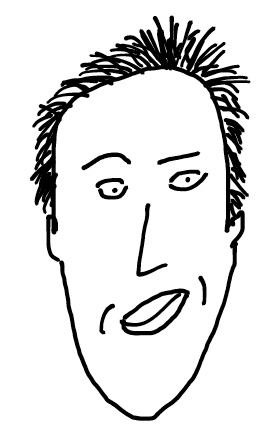
Like, you know, that one there on the left. (Pathetic, I know, but this is the kind of thing that happens when a girl gets a stylus to go with her iPad soon after finishing up Alison Bechdel’s latest book, which you should totes read, by the way.)

The idea of the Madwoman with a Laptop (ML for short!) came to me a couple of years ago when I was writing a short piece on academic feminist blogging for a collection Claire Potter (aka Tenured Radical) put together for The Journal of Women’s History. The figure was useful for thinking through questions about gender, literary history, and pseudonymity that were at the heart of that essay. It was also a satisfying way to pay tribute to the enduring influence of two of my most important teachers and mentors, Sandra Gilbert and Susan Gubar, whose monumental work of feminist criticism, The Madwoman in the Attic: The Woman Writer and the Nineteenth-Century Literary Imagination, remains a standard in the field.

I don’t know why it took me so long to realize the Madwoman with a Laptop would also be a kick-a$$ framework for a blog, but no one has ever accused me of being quick to change. I am after all an academic and thus an incrementalist at heart. I also felt great loyalty and attachment to the beloved critter who made me a dog person as well as a blogger. Ready or not, however, I’m changing now. I hope you’ll come along for the ride and take a glimpse at the world through the Madwoman’s eyes. Who knows what you will see and what we might be together? Stay tuned, my pretties.