2012: The Year in Madness, Part Deux

This post brought to you by the Department of Arts and Entertainment, ™Madwoman Enterprises, LLC. For an idiosyncratic survey of the mostly political Madness of 2012, scroll down or click here.

This post will be even more idiosyncratic than the previous one was, shaped as it is by the peculiar tastes of a couple of cranky old broads who miss most of the good movies because they tend to get released during the college basketball season and keep forgetting to tune into the shows that all the cool kids are watching. Breaking Bad? Mad Men? Girls? Game of Thrones? Oh, for heaven’s sake, people, we’re already planning to catch up on The Wire when we’re settled into the nursing home. Add these to the list, and let’s move along to a few things we actually did see this year.

Mad TV: Dorothy helpfully reminded us in a comment on the previous post that one of the year’s best and Maddest moments in live TV was Karl Rove’s election-night meltdown on Fox News, as he spluttered that Fox and other networks should not be calling Ohio — and thus the election — for Obama. It was an epically entertaining moment and a comedown long overdue in our humble opinion. Karl Rove has been a boil on the backside of American politics for more than two decades. It was thrilling to watch the boil get publicly lanced. See it here. Oh, and for a deliciously conspiratorial take on the diabolical plot that might have fueled Rove’s meltdown, go here.

HomelandTVSeriesAs for non-live TV, we are at least cool enough to have been fanatically devoted to Homeland in its sophomore season, despite some of the improbable plot twists and allegations of overacting on the part of Claire Danes. (We reject those allegations, because, well, we look goofy when we cry, too. Don’t judge.) For us, what makes Homeland white-knuckle television is the radical ambiguity of both lead characters, the soldier/terrorist/double agent Nicholas Brody (played by Damian Lewis) and the bipolar CIA analyst Carrie Mathison. In scene after scene, the evidence is split 50/50 on fundamental questions about each of them: Was Brody in on the attack on CIA headquarters, or was he a patsy, a pawn in Abu Nazir’s last brilliant plot? Does Carrie really love Brody, or is she playing him in hopes of getting useful information? Mandy Patinkin‘s Saul Berenson was also riveting this season, especially in the last couple of episodes, as he grappled with the corrupt machinations of his supervisor David Estes (David Harewood) and the possible loss of Carrie. Homeland explores, with greater nuance and insight, what’s become of the American soul in the wake of the attacks of 9/11/01. If you aren’t watching it, you should be.

Everything else we watch is cotton candy compared to Homeland. Shonda Rhimes’s Scandal is entertaining, but there’s concern on our couch that it’s already gone the way of Grey’s Anatomy halfway through its second season. I mean, srsly, kids, you’ve got a show centered around a presidential administration and you shoot the big guy in S2 — Where do you go from there? Does the guy live and become a doddering Reagan, leaning on a conniving First Lady, or do you sacrifice your credibility by having him miraculously awaken from his long winter’s nap from wounds that seemed Kennedy-esque in their gravity? Or do you let him die and worry later about what to do with all of Liv’s libidinal energy, not to mention all those pesky co-conspirators who helped get Bush Fitz into the White House? We shudder to imagine how this plot might resolve, but we’ll tune in January 10 when new episodes resume to see. CBS’s The Good Wife with the incomparable Julianna Margulies in the title role is less melodramatic but sometimes so polished that we forget who or what we are supposed to care about. Do you know what we mean? The actors are extraordinary and the writing impeccable, but, well, are Alicia and Peter really married, and will that demented/creepy husband of Kalinda’s please just go away?

NBC-Revolution-Promo-Preview-1x01-086Also: Nashville, starring Connie Britton. Watch it. Jill Dolan explains whyParks and Recreation, when we remember to tune in. Revolution, because I need guidance on how to survive power outages. (Bear in mind, though, that I’m alone on the couch for this show. WFKG won’t watch it anymore — The plots are too thin and the body count’s too high for her taste. I can’t explain what it is I keep hoping will happen here, dramatically or politically.)

Mad Flicks: Lincoln, you had us at “The Gettysburg Address,” even if that moment was totally fabricated. Forgive us, history pals. We love narrative, and this was some fine cinematic storytelling. And Daniel Day-Lewis should get an Oscar just for getting out of bed every morning. He is incredible, here as everywhere. Les Misérables was pretty swell, too, for entirely different reasons, most of which involved the extreme hummability of songs I cannot get out of my HEAD! Stacy Wolf lets us off the hook for loving a show with such atrocious gender politics — Go read that piece, and then get thee to the multiplex, citoyen. We saw The Master and kind of scratched our heads over it, but it’s on a bunch of other Best of 2012 lists, so what the heck. The pas-de-deux between Joaquin Phoenix and Philip Seymour Hoffman is pretty fricking compelling.

Mad Moments in Sports: In March, our beloved Lady Terps won the ACC championship in basketball but then went on to suffer a stunning 31-point loss to Notre Dame in the Elite 8 round of the NCAA tournament. (The adorable and ridiculously talented Brittney Griner and Baylor would go on to win the tournament, so we weren’t hugely disappointed by the fact of the Terps loss, only its scale.) In the summer Olympics, we thrilled to the classy, emphatic swan song of swimmer Michael Phelps and the fearless grace of gymnast Gabby Douglas. Though of course what we really loved about this Olympics was Queen Elizabeth’s star turn in the opening ceremonies and the McKayla Maroney is not impressed meme launched by a photograph of the gymnast’s disappointed expression on the medal stand when she won silver in the vault competition. The sports lowlight of 2012? That award goes to lying sack of performance-enhancing drugs Lance ArmstrongSports Illustrated has a great piece on the year’s biggest moments in sports. It’s here.

Mad Musical/Theatrical Interludes: We saw Madonna this year. Nothing else matters, though Kathleen Turner was fun to watch as Molly Ivins in Red Hot Patriot. Still: Madonna.

gubar debulked womanMad Reads: On the New York Times list of 100 Notable Books of 2012 you will find a brave and beautiful book by one of the original Madwomen, Susan Gubar, whose chronicle of life with ovarian cancer, Memoir of a Debulked Woman, is making waves among those affected by the disease and those who treat it. Gubar was diagnosed more than four years ago with advanced ovarian cancer, which was treated with a surgery called “debulking,” which removed  her uterus, ovaries, fallopian tubes, appendix, and seven inches of her intestines. The surgery was followed by complications and many rounds of chemotherapy that Gubar undertook with mixed feelings, because she appreciated the gravity of her diagnosis and didn’t want to subject herself to treatments that had no real chance of succeeding. The book unflinchingly recounts the physical and emotional aspects of her ordeal. It is a harrowing story but one that ends up inspiring, even though its author consciously positions her story against the chirpy American fantasies of beating this thing that structure most cancer narratives and the pretty-in-pink movements of cancer survivors. Gubar is not a believer in miracles. She rejects false hope and refuses to traffic in euphemism, though she is careful not to deny hope to others. What’s inspiring about her story is precisely its emphasis on endurance and on the consolations of love, art, and literature. Memoir of a Debulked Woman is about navigating the final stages of life without illusion but with a quiet persistence that amounts to grace. I am not objective about Susan Gubar. She was my teacher and remains a friend. She has written a book that matters profoundly and is now blogging on living with cancer on the New York Times website. She is still, always, brilliantly teaching. (The New Yorker has a print interview with Gubar on the subject of the book, her illness, and the need for women to educate themselves about ovarian cancer. She talks through those issues — in her glorious, straight-out-of-Brooklyn voice — with NPR’s Neal Conan on Talk of the Nation.) Thank you, Susan, and happy new year to you and yours.

Most Madly Wonderful Photo of the Year: So, this is what marriage equality looks like:

Larry Duncan, 56, and Randy Shepherd, 48, from North Bend Washington, get their marriage license on the first day it was legal for same-sex couples to do so in Washington State, 12/6/12. Photo Credit: Meryl Schenker Photography. Via.

Larry Duncan, 56, and Randy Shepherd, 48, from North Bend, Washington, get their marriage license on the first day it was legal for same-sex couples to do so in Washington State, 12/6/12. Photo Credit: Meryl Schenker Photography. Via.

Oh, homonormativity, who knew you would be so . . . lumberjacky!

(For other notable photos of 2012, please see the Star-Ledger‘s haunting collection of photographs of Union Beach, NJ at night, after the devastation of Hurricane Sandy, and the New York Times 2012: The Year in Pictures.)

Happy new year, darlings. May 2013 fulfill all of your wildest dreams or, you know, not suck entirely. Peace out, and thanks, as always, for reading.

2012: The Year in Madness

Oh, thank god there wasn't a total blackout from December 23-25, 2012 due to "an alignment of the universe." If that had happened, I would have to kill a LOT of people.

Oh, thank god there wasn’t a total blackout from December 23-25, 2012 due to “an alignment of the universe.” If that had happened, I would have had to kill a LOT of people.

This blog was born halfway through 2012, but I’m happy to offer an idiosyncratic survey of the entire year in Madness, by way of my Laptop, which is currently ensconced in a sleepy little town on the shores of Lake Michigan, where Ruby and I, along with the Woman Formerly Known as Goose, are planning to ring in 2013 in low-key style.

Before we get to the survey, though, raise your hand if, like me, you feel slightly creeped out by the idea of a year that ends in thirteen. Shouldn’t we be feeling superstitious about this? Historians, please weigh in on whether years that end in thirteen tend to suck more than other years. My research assistant Wik E. Pedia suggests that 1913 was heavy on wars and revolutions, though I suppose we might be grateful for the invention of stainless steel, which occurred in August of that year. As for 1813, well, it turns out that the (obviously misnamed) War of 1812 was still being hotly contested, but Pride and Prejudice was published, so the year couldn’t have been entirely bad. Still, let the record show that I have reservations about the coming year, based strictly on a previously undiagnosed case of traiskaidekaphobia.

So: The Year in Madness.

Mad Words: Time magazine published a long list of words that should be banished in 2013 (among them are amazeballs and zombie apocalypse, with which I wholeheartedly agree, but where oh where is double down, a phrase that totes [also on Time‘s list, but I ain’t giving it up] annoys me as one of the poorest substitutions for thought I have ever encountered). Because I am a glass half full kind of gal, I offer in reply to Time a short list of expressions I shall always be grateful to dear old 2012 for producing:

Yes, thank you, Congressman Todd Akin and Commonwealth of Virginia, for finally putting the GOP’s maniacal determination to control women’s bodies in terms that galvanized attention and motivated large numbers of people to wake up and vote against extreme right-wing candidates. Which, I’m pretty sure, contributed to the next Mad item in my survey.

Madness Averted: On November 6, a majority of American voters sensibly chose not to let this guy add the White House to his long list of homes:

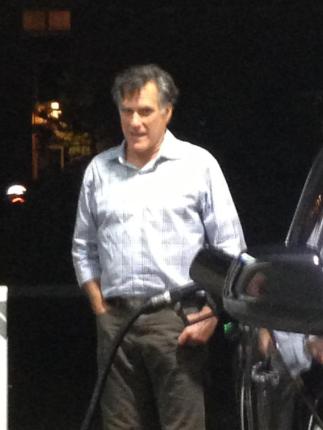
Mitt Romney at a gas station in La Jolla, CA. Via

Mitt Romney at a gas station in La Jolla, CA, 11/19/12. Via.

Need I say more?

Madness Goes Public: Call it the prequel to the item above, my favorite political moment of the year was definitely Clint Eastwood’s speech at the Republican national convention. I predicted that Romney would lose and that this moment would be “blamed for thwarting Romney’s momentum by crystalizing for voters the race and class resentments that are the heart and soul of today’s Republican party.” I think I was right. Thank you, Mr. Eastwood, you grumpy old man of the year.

Clint Eastwood at the Republican National Convention, 8/30/12

Clint Eastwood at the Republican National Convention, 8/30/12

Mad Feats: Let us not forget that 2012 was the year in which a dude hurtled 24 miles through space at speeds as fast as 834 mph on his way to setting records in altitude for a manned balloon flight and parachute jump and the greatest free fall velocity. Uh, wow. I bought a treadmill. Does that count?

Mad Surprises: Marriage equality wins on the ballot in not one, not two, but THREE states in the November election, including the great state of Turtle Country. Wow. Just wow. But don’t order those toaster ovens yet. WFKG and I have still not committed to getting married. Stay tuned.

Mad Satisfaction: Who are the two most popular politicians in the final NBC-Wall Street Journal poll of 2012? Why, Bill and Hillary Clinton, of course, and if you are surprised by that news, you haven’t been paying attention. Also, Nate Silver is smarter than you are, but it’s okay — He’s smarter than everybody. Deal with it.

Mad Losses: Death had a big year in 2012, as it generally does. We note with sorrow the number of sheroes who left the building this year and console ourselves by imagining that the afterlife, whatever it may be, has a number of glorious new contributors to its word/soundscape: Nora Ephron, Whitney Houston, Etta James, Jenni Rivera, Adrienne Rich, Donna Summer, Chavela Vargas. Also, Sally Ride, a lesbian who orbited the earth. Speaking of astronauts, Neil Armstrong, a man who walked on the moon, died this year, too. Finally, Larry Hagman was not a woman, an astronaut, a poet, or a singer, but we worry what will become of the spectacularly cheesy new remake of Dallas without him, and so we mourn his passing, too.

Madness in School: In June, University of Virginia President Teresa Sullivan abruptly resigned over a “philosophical difference of opinion” with the university’s governing board. The disagreement appeared to be over the pace of change happening at the academical village founded by Thomas Jefferson, particularly with regard to online education. Two weeks later Sullivan was reinstated after a tidal wave of protest and negative publicity both on campus and off. Two weeks after Sullivan’s reinstatement, UVA announced it was joining a group of 12 institutions planning “to open their courses to the world, free of charge, through an online platform created by the start-up company Coursera.”  And so the brave incrementalist so staunchly defended by the apostles of shared governance and the academic community of trust turns out to be just one of the herd, her voice blending into the soothing chorus of MOOC, MOOC, MOOC. What can that mean? Where will it lead? Heck if I know, kids. I hate what UVA’s board did in booting Sullivan and am tickled pink she got her job back. MOOC’s are the big story in higher ed this year, but I have to confess I am among the foot-draggers, the nay-sayers, and the worry-warts who fear that we may be putting the final nails in our own coffins by jumping on this particular bandwagon. Some days, I walk across my lovely campus and wonder, Which of us will be asked to turn off the lights in the last of these red brick buildings? Who will we be when the last of the turtles has lost its shell?

Madness in School, Part II: December 14: A guy, a rifle, and 26 corpses. (27 if you count the shooter’s mother, killed at the home they shared before the shootings at the school; 28 if you count the shooter’s fatal self-inflicted wound.) God, where will it end?

Lord, even an idiosyncratic year-end survey is exhausting! And at times depressing. I’ll stop here and try to do a follow-up post focused on the year in artsy-fartsiness, because that’s the kind of thing folks expect from an English prof spouting off on the Interwebz. Meantime, feel free to weigh in with your picks for the Maddest Moments of 2012. Tell me what I missed, Madpeople at your Laptops!

Holidazed

Contemplative Ruby, Christmas Eve, 2012. Photo Credit: The Madwoman

Contemplative Ruby, Christmas Eve, 2012. Photo Credit: The Madwoman

Happy Holidays from the Madwoman and all her furry and non-furry companions. Ms. Ruby is celebrating her second Christmas as part of our pack in Michigan with cousin Scooter and the two sisters of the Madwoman. Ruby found it hard to concentrate on Elf last night (see TV screen in background of photo), what with all those adorable, chewable Snoopy dogs hung by the chimney with care. She stared at them longingly, sure that Santa intended them for her. She was wrong, but who among us has not had to fight off some mild feeling of disappointment amidst all the joy of the holiday season?

Be well, my pretties, and full of joy and good food and warmth. Peace out.

What I Could Do

Photo Credit: The Madwoman, 12/16/12

Photo Credit: The Madwoman, 12/16/12

Dear Students,

You are not six and seven year olds, saucer-eyed, cherubic, believers in Santa Claus. And I am not a 27 year old over the moon with her first job. Or a principal who would dress up in goofy costumes to help students connect with the fun of learning. No. You are in your twenties, and I wear slacks and sensible shoes without worrying too much about whether that will help you wrap your minds around the ambiguities and instabilities of gender.

We will meet this afternoon for your final exam. It is the Monday after a mass killing in which twenty children lost their lives. It is eight days before Christmas. Early in our semester’s study of theories of literature and sexuality, we read a brief excerpt from Eve Sedgwick’s Tendencies, a chunk from the introduction usually referred to as “Christmas Effects.” In it, Sedgwick comes at the question, “What’s queer?” by examining the ideological force of heteronormativity. To help explain what she means, Sedgwick begins with a riff on “the depressing thing about the Christmas season” as a moment when all our institutions speak with one voice and seem to be saying the same thing. The languages of church, state, commerce, and media are all lined up in what she terms “the Christmas phalanx.” Among the examples Sedgwick cites to prove the tautological and coercively normalizing force of the holiday is this one:

[A]d-swollen magazines have oozing turkeys on the cover, while for the news industry every question turns into the Christmas question — Will hostages be free for Christmas? What did that flash flood or mass murder (umpty-ump people killed and maimed) do to those families’ Christmas?

You loved this piece when we read it earlier in the semester. Sedgwick’s playful yet probing analysis of the tyranny of Christmas helped you see the point that queer is a way of describing more ragged and less depressing moments/spaces when everything emphatically does not mean the same thing, when things don’t line up neatly and march in lock step. Queer, says Sedgwick, is “the open mesh of possibilities, gaps, overlaps, dissonances and resonances, lapses and excesses of meaning when the constituent elements of anyone’s gender, of anyone’s sexuality aren’t made (or can’t be made) to signify monolithically.”

I asked you to review these few marvelous paragraphs in preparation for today’s final. I promised to bring holiday cookies to the exam, a double batch of my favorite cookies from my own Christmas-effected childhood. I stayed up late last night, making the cookies and not getting through all the papers I had hoped to have graded by this afternoon. As I delicately rolled the buttery dough into little balls and lined them up on my battered cookie sheets, I thought of you, and all the work we have done together this term in the unlocked classroom of a wide open building. I thought of the umpty-ump people killed and maimed and wondered, not for the first time, if I would be brave and selfless enough to take a bullet for you, my students.

I cannot answer that question. No one can, in the abstract, know the answer to that question. One can only hope that in a moment of crisis one would be decent. And clever. I am reading your papers, slowly and with care. I marvel at your effort. I see the kindness in your faces. Try not to lose that, ever. I made you cookies. It’s what I could do. Yes, Eve, it is a depressing season. Let’s have a cookie and ride it out together.

In peace,

Your Teacher

Saving the Humanities, Gangnam Style

So, this was on Glee Thursday night:

Which made me think it’s high time we commissioned some time use studies to see just how much time has been spent across the dying globe watching or producing “Gangnam Style” covers and parodies in the past four months. Seriously, people, I’m pretty sure the Bureau of Labor Statistics is going to need to put a new slice in its pie chart to account for this astonishing phenomenon in its 2012 survey of lies people tell about how they spend their leisure time. (Eighteen minutes a day each for reading and exercise seems refreshingly honest, but 26 minutes for farting around at the computer? Gimme a break.)

The slice for “Watching or producing Gangnam Style covers and parodies” should of course be pink, in keeping with the insanely kitschy style of the original by South Korean rapper PSY. (Go on. Click on that link. We’ll wait. For the entire 4 minutes and 13 seconds if we have to. This is work time for you, darlings: cultural studies.)

Now that you’ve seen the original, go destroy a few brain cells do a careful study of a few parodies, including this excellent one produced in the QTU library (featuring a turtle, a marching band, and the dean of the libraries!) or this diabolically witty one called “Mitt Romney Style.” I’m reasonably certain it explains why Obama won the election.

You are probably wondering at this point how in the name of Judy Garland I managed not to convince GayProf, Historiann, and Tenured Radical to do a Gangnam Style parody on the beach in San Juan a couple of weeks ago. I apologize to each and every one of you for squandering this exceptional opportunity to bring Western civilization to a crashing, cheesy, glorious end. As you can tell from the photo at the bottom of this post, three out of four of us were scantily clad and sporting huge sunglasses in San Juan. GayProf no doubt had plenty of extra tiaras and knee-high red boots in his suitcase(s). The Woman Formerly Known as Goose was there with a camera, more than ready to point, shoot, and tell people where to go. (Oh, wait, she did that.) It would have been the parody to end all parodies. It would have made “Call Me Maybe” a minor footnote in the history of virality. It would have made “Academic Tim Gunn” look totally five minutes ago. It would have made “Texts From Hillary” — Wait, no, some things are sacred, aren’t they?

Just so we’re clear: I totally heart “Gangnam Style” and its thousands upon thousands of goofy imitations. I’m fascinated by the phenomenon — as is no less a thinker than Zizek, by the way, so don’t judge, biatches. (Again, click on that last link: You need to see a nose-pulling Zizek explain how Gangnam Style is destroying Justin Bieber.) I can’t wait to read the dozens of dissertations and special issues it is sure to spawn. I predict the academic job crisis will end when armies of PhDs are hired to staff the departments of Gangnam Studies that will spring up when entrepreneurial deans of colleges of arts and entertainment sciences throughout the land realize that this is a sure-fire way to prove they are cool culturally relevant. Yes, darlings, “Gangnam Style” is the cure for what ails us in the age of Excellence Without Money (™RW Enterprises, LLC). Who are we to argue with 861 million views? Who among us has not longed to ride an invisible horse? (Looking at you, cowgirl.) You want Massive, dudes? I’ll give you Massive.

Sometimes, kids, you have to destroy the discipline in order to save it. Let’s do it, Gangnam Style. Don’t forget your sunglasses.

Op op op op oppan Gangnam Style.

Cheesecake and Gratitude

Pumpkin Hazelnut Cheesecake,Thanksgiving Eve Dinner, 2012.
Food Prep, Styling, and Photo by The Madwoman.

We’re about to hit the road for holiday fun and feasting with pals up the I95 corridor, so I can’t linger here on the interwebs, but it wouldn’t feel like Thanksgiving if I didn’t pop in with a recipe and a word or two of thanks for the finest bunch of readers on dog’s earth. Thanks to everybody who made the journey from the old blog to the new blog this year, and thanks to the newbies who stumbled upon a Madwoman in the course of their restless roving through cyberspace and decided to give her a click. We are grateful for your eyeballs, your pithy/thoughtful comments, and your big, beautiful hearts.

The Woman Formerly Known as Goose and I are breaking with Thanksgiving tradition this year in traveling rather than hosting (blame it on San Juan), but we had a swelegant little fete last night to celebrate with the hometown crew. Dessert was the smooth as silk pumpkin hazelnut cheesecake featured in the photo above. It’s a new recipe from Food Porn for the Conscientious, and I was delighted with how it turned out. The chorus of oohs and aahs around the table suggests that the guests were pleased, too. The recipe calls for hazelnut flour, which I couldn’t find, so I used almond flour instead. I also subbed almond extract for vanilla (because we were out), and that worked fine. I was especially pleased with how the hazelnut brittle sitting atop each slice came out. I am not terribly adventurous as a baker and don’t go for fussy ornamental details, but this was easy and impressive. Oh, and tasty! Turns out I like hazelnut brittle. Who knew?

Gotta run, darlings, or WFKG will start grousing at me for holding up the Thanksgiving parade. If you’re in need of a last-minute appetizer guaranteed to please your guests and keep them sober by soaking up a lot of booze, run over to the old blog and pick up the recipe for Janie’s olives. My beloved grandmother knew that what the world needs now is love and a bunch of olives wrapped in cheddar cheese dough. It’s a formula that has worked well for me, so I’m happy to pass it along to you.

Have a glorious day, little pilgrims and anti-pilgrims. Eat well. Laugh loudly. Focus on the good stuff. Repeat, with gusto.

Swimming and/as Schmoozing

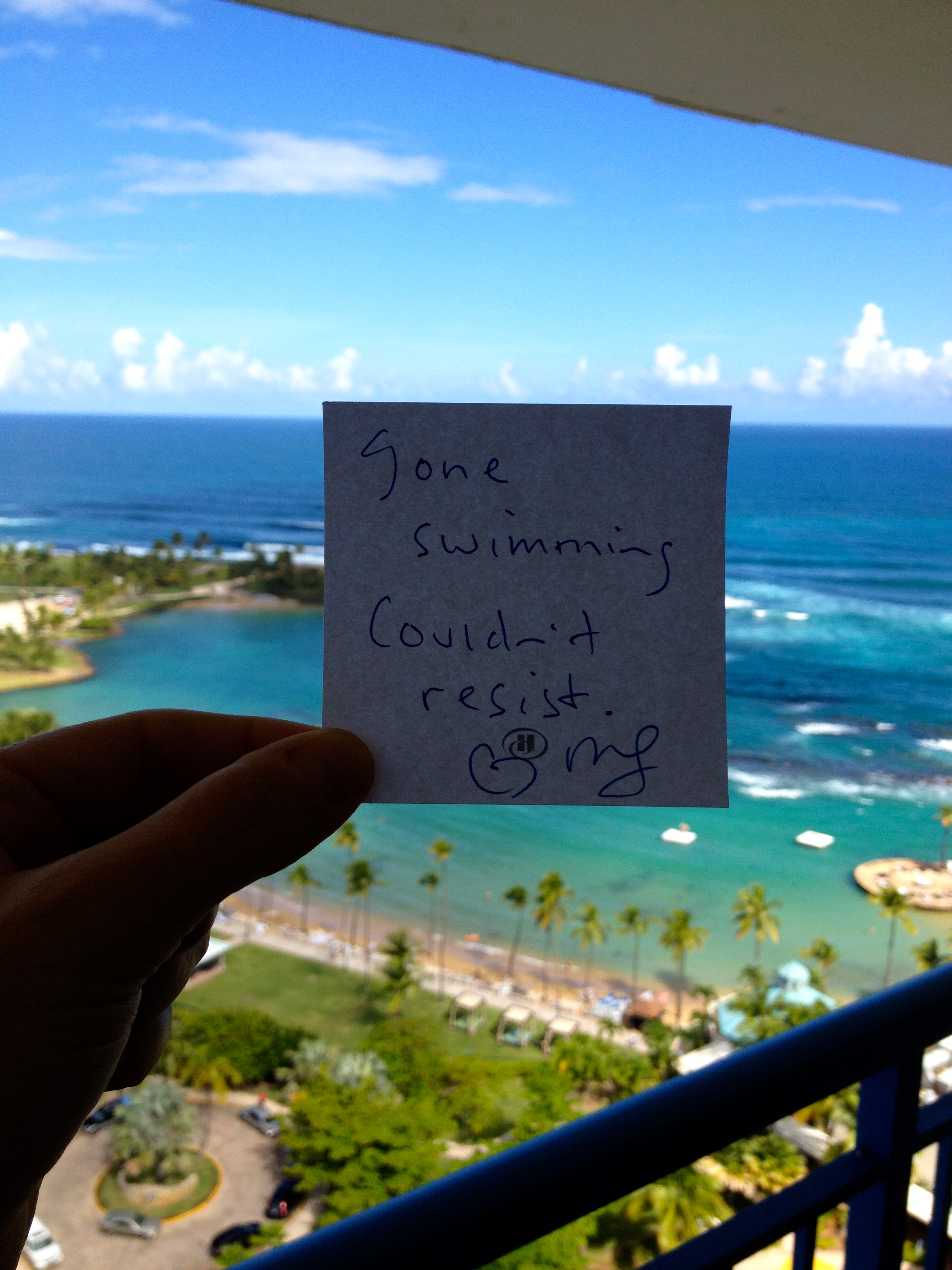
From the balcony of the Caribe Hilton, San Juan, PR. Photo Credit: The Madwoman, 11/16/12.

I won’t lie. I haven’t attended a whole lot of sessions here at the American Studies Association annual meeting in San Juan. The time has felt rewarding and rejuvenating, both professionally and personally, but most of the benefits have come from informal contacts and serendipitous conversations that occurred outside the formal structure of the conference. Should I feel bad about having a significant discussion about  the state of my career with a senior colleague in my own department while bobbing around in the emerald green waters of the Caribbean? Or about spending 45 minutes chatting with someone whose work I’ve long admired while standing at a poolside bar wrapped in a towel? Should I feel less bad if the upshot of the conversation was an invitation to speak at a conference I am hosting in the spring? Oh, and if I extracted the promise of a syllabus for a course similar to the one I’ll be teaching next semester?

Actually, I don’t feel bad at all about how I’ve spent my time here. I offer these reflections in response to a post by Tenured Radical addressing a reader’s queries about academic conferences in suspiciously beautiful places. I”ve attended a few sessions, participated in one — with TR, Historiann, GayProf, and our fearless moderator, the Woman Formerly Known as Goose — and hit as many parties as time and stamina allowed. I am a firm believer in the value of live, person-to-person contact and in getting out of one’s usual routines and habitat as a way of shaking things up. I doubt seriously I would have had quite the same candid exchange with my own colleague over coffee back in Turtle Country. Further, our session on blogging as public pedagogy was lively and well-attended. It sparked a conversation that continued for many of us for the rest of the conference. I suspect it will continue by several means for a long time to come, and if WFKG has her way it will likely lead to a collection of essays on the session theme. Stay tuned, darlings, because WFKG can be very persuasive.

Yes, I had to do some rearranging of life and work in order to be here, and it does mean I am about to be hurled into Thanksgiving week a little further behind than I’d like to be. Still, the journey and the work have been worthwhile, if only because I finally got to meet GayProf and Historiann in the flesh and discovered that they are as delightful and charming in person as they are on screen. I was taken aback that Historiann did not ride in on a horse and GayProf seems not to have flown in on an invisible plane, but I suppose they might have been a little surprised that I was neither a dead dog nor an actual madwoman. I did bring a laptop, though, so perhaps that took the edge off their disappointment.

Conferences are good, and the work at conferences occurs in a variety of ways and locations.

Which is why, my pretties, if you’re still in San Juan, you may find me bobbing around in the emerald green waters of the Caribbean along about noon today. (Our flight doesn’t leave until this evening.) Stop by for a chat. It might be professionally advantageous to both of us.

The Entirely Bearable Weirdness of Winning

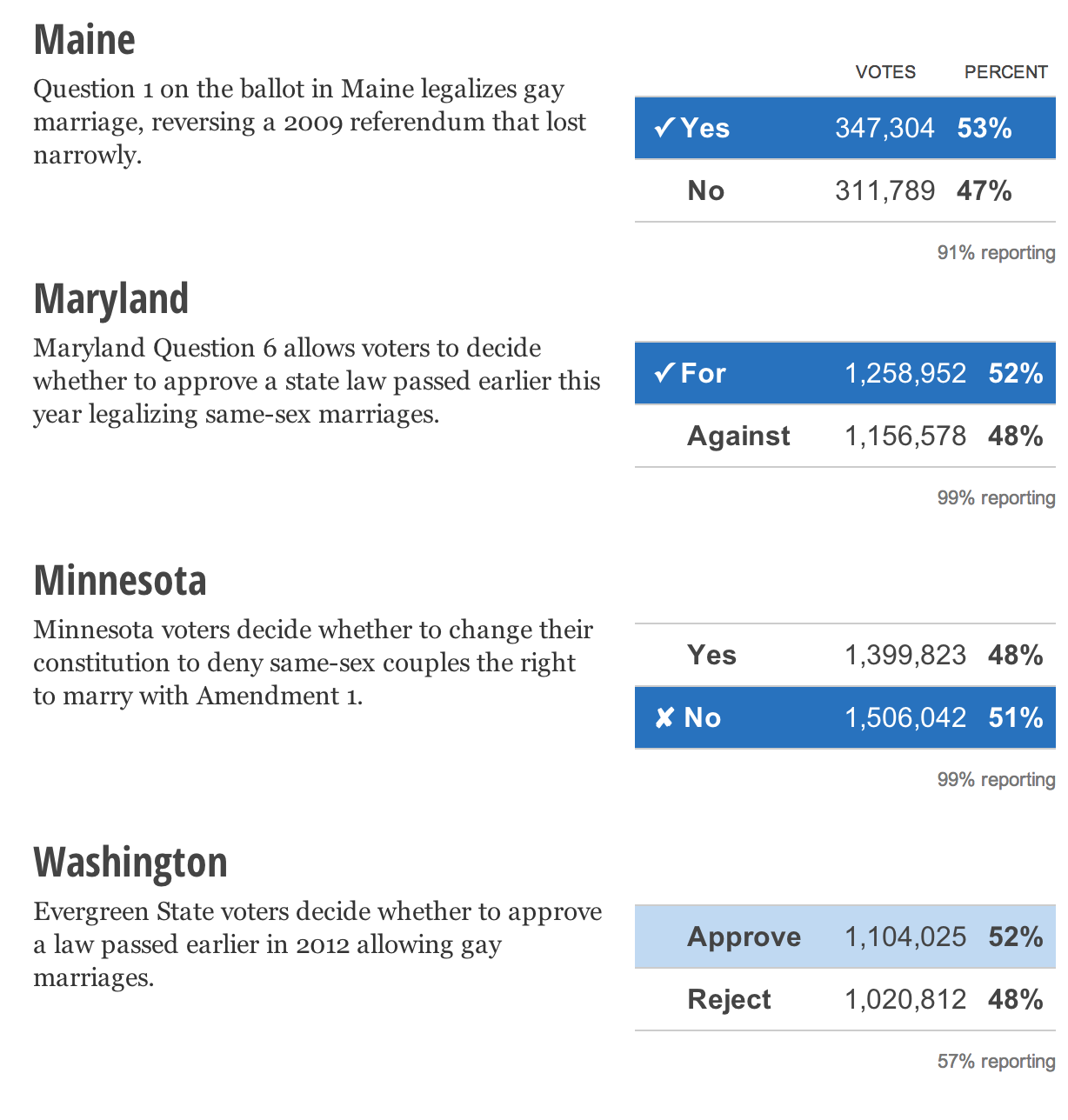
Results of the four ballot initiatives on same-sex marriage in the 2012 election. Via.

What a difference four years makes. In 2008, the thrill of the nation electing its first African-American president was accompanied for many of us by the bitter disappointment of seeing voters in four states, including California, approving measures that prohibited same-sex marriage or adoption by gay couples. A few days after the election, I wrote that perhaps it was time for those who cared about LGBT rights to abandon the cause of marriage and to seek protections for same-sex relationship by other means or at least by other names. I was tired of watching my community waste its limited energies and precious resources on what felt, after dozens of defeats at the ballot box, like political insanity — doing the same losing thing over and over again and expecting different results. Here is what I proposed as an alternative:

[I]f the issue is gaining legal protections and economic benefits for queer households, does it matter if we call it “marriage”? If the straight majority is dumb enough to grant us all those things – and I do mean all, including the full panoply of federal benefits extended to married couples — as long as we call it anything other than “marriage,” then maybe we should take the deal and throw ourselves a victory party. I know, I know, separate is still unequal, but, but, but – Aren’t we tired of going through these motions over and over again and never really getting anywhere? Aren’t we sick to death of seeing the collective energies and resources of our small community sapped by the ridiculous effort to prove we deserve access to an institution that has been oppressing women and stymieing the relational imagination for centuries?

Yeah, I was tired. And more than a little frustrated. You have to admit, though, that plenty of folks seem willing to extend those benefits to the gayz as long as we call the institution, say, poop on toast rather than marriage, so, hey, why not? Po-tay-toh, po-tah-toh, right?

So, anyhoo, fast forward to Tuesday, November 6, 2012. There are four marriage measures on ballots in four cobalt-blue states, including my home state of Turtle Country. Incredibly, they all win (though we are still waiting on full, final results from Washington State). Just like that, the tide of history is turned! Suddenly, the impossible has become the achievable — indeed, the achieved. Insanity has become like, hey, no big deal, are you guys registered at Pottery Barn?

How did we get here in just four years? Heck if I know. I’m an English prof, not a pundit or a data nerd. My hunch is that generational change and President Obama’s endorsement have done a lot to change the climate of opinion on marriage equality. The losers in Tuesday’s battles claim they were outspent three to one in the ballot campaigns, so perhaps spending money can help win elections, though that obviously wasn’t the case in a lot of the races on Tuesday. On the ground in Turtle Country, I think we can credit smart organizing and good messaging for increasing support, particularly in the African-American and Latino communities. Equality Maryland, the state’s largest LGBT civil rights organization (on whose board I happen to serve) worked in coalition with Latino groups to help pass a state Dream Act. About a quarter of registered voters in Maryland are African American, so a lot of pro-6 ads featured civil rights leaders such as Julian Bond and NAACP president Ben Jealous, as well as faith leaders such as the Rev. Delman Coates of Mount Ennon Baptist Church in Clinton, MD. This time, supporters of marriage equality didn’t hesitate to frame the cause as a civil rights struggle, and the message seems to have helped drive up support in the African-American community. Question 6 lost by just 4000 votes in Prince George’s County, which is 64.5% black, and African-American support throughout the state was close to 50%.

A couple of weeks ago, I mused here on how deeply estranging and uncomfortable it felt to know that my friends, neighbors, coworkers, and countless unknown fellow citizens would be voting on what felt like a referendum on my humanity. I told you that I was feeling reluctant to talk to my neighbors about Question 6 because I wasn’t sure I could bear to know that they might vote against me. I never could bring myself to knock on their doors and initiate those conversations, but because the universe is small and endowed with a perverse sense of humor, I ended up spending much of election day handing out pro-Question 6 materials at my own polling place. Which meant, of course, that I saw all of the neighbors I had been avoiding talking to. Minutes before my shift at the poll was scheduled to end, a group of women drove up together in a large, spotlessly clean SUV that I instantly recognized. In the bright sunshine of a beautiful November day, in the parking lot of an elementary school, we smiled and greeted one another warmly, with that giddy kind of excitement those who participate tend to feel on election day. I asked if they would like a Question 6 flier, and they all accepted one. Then I hesitated for just a moment before deciding to make a little leap of faith. “Now,” I said, “we haven’t talked about this, but I’m hoping we can count on your support.” To a woman, they nodded affirmatively or said yes, I could. Mine was the last face they saw before they stepped inside the school to vote.

Look, I’m no fool. I know people lie in social situations in which the truth would be awkward. I’ve been smiled at a million times by those who believe they can love me while condemning the sin of my lifestyle. I know it’s possible my neighbors were merely being polite, but as I walked home on Tuesday afternoon I promised myself that if equality prevailed in the election I was going to believe that my experience at the poll was the universe’s way of telling me I should never have doubted the hardworking people who share my lifeworld.

And I do believe that. Because this week, things that felt impossible four years and even six months ago have suddenly become real. This week, it is no exaggeration to claim, as the coalition who helped to pass Question 6 declared, that We made history. We did, and it feels good. The weirdness referred to in my post title is the weirdness of winning after so many losses. After 32 defeats, you begin to feel like Charlie Brown’s baseball team or, you know, the Washington Mystics. You can’t imagine winning and you try not to as a way to protect yourself from the disappointment of yet another defeat. When victory comes — or four victories in one astonishing night! — you hardly know how to react. You laugh, you cry, you hold tightly to those who are close to you, you shake your head in a mixture of joy and disbelief. Two days later, it still feels slightly unreal. Two days later, I think a message I put up on my Facebook wall after a few hours of not very restful post-election sleep best captures my feelings about this delightfully strange moment:

Friends, my heart is so full and my body so weary that I can’t speak yet about what last night meant, here in Maryland and all across the country, for the nation I love and the values I hold dear. For now, all I can say is thank you, to everyone who worked so hard and so faithfully to bring about so many large and small victories for fairness, equality, and inclusion. We are not a perfect nation this morning, but we are better than we were yesterday. And if we keep working the way we have these past few months, then by golly we’ll keep getting better, bit by bit, together.

Yes, we can — because we have. Thank you for your hard, good work.

The nation I love and the values I hold dear? Yeah, sometimes a girl just wants to wave a flag. Deal with it, darlings. And don’t ask me when the wedding is. This queer against marriage but for marriage equality ain’t budging on that point. Yet.

Stay tuned.

Sandy: Here, There, Everywhere

Hurricane Sandy: On the Deck, Micro View. 10/29/12.
Photo Credit: The Madwoman

We are fine, darlings. All is well here in the place formerly known as Roxie’s World. We spent most of yesterday sitting around waiting for the power to go out, because it does “every time a butterfly flaps its wings,” as the Woman Formerly Known as Goose quipped this morning. Incredibly, it did not, despite fierce winds and relentless, driving rains. We had dutifully cleaned out gutters and set out candles and checked flashlight batteries and even cooked up a batch of chili that we were prepared to live on through days of grim, sad darkness. I filled my Facebook feed with jokes about getting ready to start killing neighbors as soon as the lights went out, because that’s what I’ve learned about how to survive a power outage from NBC’s utterly ridiculous Revolution. (Yes, I do hereby declare it ridiculous. I kept watching, hoping the show would get less gory and more political, but the bodies keep piling up and the story, such as it is, isn’t especially compelling. So far, Revolution, you are no Hunger Games and certainly no Homeland. Call me if you ever get past the whole Lord of the Flies thing.)

So, we were lucky. The lights stayed on. The neighbors are all, so far as we know, alive. If the chili gets eaten by candlelight, it will be because we are feeling romantic. We can go back to worrying about the election and the fact that, according to one new poll, our humanity has suffered a setback and may lose next week in Turtle Country. (Our humanity fares better in another poll, but it’s suddenly hard to feel confident that marriage equality will win anywhere, despite recent gains in support.) We can go back to work. The university will reopen tomorrow. Syllabi will be modestly adjusted, deadlines slightly extended. We can laugh lightly in the hallway with colleagues over how rain days are just like snow days, without the shoveling. We can make a quick trip to the store to stock up not on bottled water but on treats for Halloween.

Others, of course, will not have those luxuries, will not return so quickly and easily to anything like their normal, pre-Sandy lives. The news and images coming out of New York and New Jersey are devastating. My Facebook feed today is full of anxious queries and brief reports: How are you? . . . . I’m trying to reach my parents . . . . Lights out in Jersey City . . . . No latte in my neighborhood bodega . . . . Come see us if you need power or a shower . . . . Post-hurricane rainbow, as seen from my balcony in Brooklyn . . . . 

You can see that lovely rainbow here, along with Tenured Radical’s eloquent analysis of how helpful Twitter was for those living through the disaster unfolding in New York. TR is right. Twitter can’t be beat for real-time sharing of information in moments of crisis. Facebook, as my string of quotes and paraphrases above suggests, is better for making more personal connections, sharing feelings, carrying on conversations. And so the Hurricane Sandy story is, like all storm stories, a tale of disparate impacts and the vagaries of weather, but it is also, like so many large-scale events of the twenty-first century, a tale of disparate social media — of what we use when, how, and why and how we are used by them; of how having such tools changes our experience of such events by shrinking distances and giving us access to stories traditional media might miss. The cliches of techno-culture are validated in such moments: We are all reporters, producers, and broadcasters, as long as our smart phones don’t get swept away in the flood and we can manage to transmit data.

Really, though, the Sandy story is the oldest story in the book: Humans are social animals. We crave connection and will find it, in raging storms and seas of tranquility, by whatever means are available to us. Including public pay phones, which, apparently, still exist. I know: Who knew?

Wherever you are, I hope you are warm, safe, dry, and connected. Feel free to tell us your storm stories or to weigh in on the whole Twitter v. Facebook debate, unless you don’t use either of them, in which case you are not allowed to have an opinion. (Looking at you, PhysioProffe. Be nice.) Peace out.

The Unbearable Weirdness of Being Voted On

My humanity is up by nine points in Turtle Country, according to the latest Washington Post poll on the referendum that would extend the right of civil marriage to same-sex couples.  The poll of likely voters shows that 52% intend to vote yes on Question 6, while 43% say they don’t have a homophobic bone in their bodies but are pretty sure the Lord God Almighty thinks that Edith Windsor should have had to pay $363,053 in federal estate tax after her partner of 44 years, Thea Spyer, died in 2009. Wow, who knew the Lord was such a micromanager?

My humanity is also leading in Washington state, by the way, and doing well in Maine. Things are little shakier in Minnesota, but it’s possible my humanity will prevail even there, depending on turnout and how the undecideds go. No lead is comfortable, of course, because the Not Homophobes Opposed to Civil Equality tend to lie to pollsters about how they intend to vote on questions regarding my humanity. Funny how that goes, isn’t it?

You are justified in wondering why a Madwoman Opposed to Marriage But in Favor of Marriage Equality has come to see the election in such dramatic terms, as a referendum on her very humanity. Oh, well, you know, that’s what happens when one’s fellow citizens — neighbors, friends, coworkers, and relatives as well as millions of strangers — hold one’s rights in the palms of their kind or unkind hands. The stakes feel both high and personal, because they are. One cannot not care, even about a 15-year-old African American boy whom one reads about in the (online version of the) newspaper, whose mother explains his opposition to same-sex marriage this way: “He is very accepting of people with alternative lifestyles, but doesn’t believe they should be able to get married.” Fifteen-year-olds cannot vote, of course, but wouldn’t it trouble you to hear one so blithely judge what you should or should not be permitted to do? Wouldn’t that make you want to meet this young man, look him in the eye, and ask why and how he came to make such a judgment on your humanity or lack of it? You might briefly imagine such an encounter, mightn’t you, before you sensibly shifted the focus of your questioning to why that young man lives in a world where such matters are subjected to popular votes?

Yes, that is the question, but I can’t stop thinking about this young man. And I can’t stop thinking about my neighbors, the ones with the impossibly manicured lawns and the spit-shined cars and the “No Pooping” signs in their yards. I have known them for close to 20 years. We are on friendly terms, warm ones even. We don’t just wave and exchange greetings. We pause to talk as they rake the mulch to the edges of their perfect beds and I take Ms. Ruby out for her twice-daily constitutionals. They dote on my dog and assure me she is welcome to poop in their yards — because she is adorable and they know I will clean up after her.

We do not speak of politics, my neighbors and I. There are no campaign signs in their yards, and they don’t mention the “Vote For Question 6” sign in my yard. As the election approaches, I wonder if I should broach the subject of the referendum. I feel that I ought to, and yet I hesitate, worried about how such a conversation might go and what its aftermath might be. The threads that connect us across multiple lines of difference — of race, class, sexuality, structures of intimacy — feel enduring yet delicate. I worry that such a conversation, if it went badly, could irreparably damage something I value highly: the pleasantness of encounters I have nearly every day with individuals who are a part of my lifeworld.

I realize that my anxiety may be unfounded and that it may do my neighbors a terrible injustice. It is possible that the conversation I am avoiding would go swimmingly if I summoned the nerve to start it. Most of my neighbors don’t seem to be churchgoers, and many of the households are sustained in part by the devoted care of unmarried adult daughters. For all our front-porch friendliness, I haven’t a clue what really goes on in my neighbors’ houses, so I shouldn’t presume to know anything about their politics. I shouldn’t, and I don’t really, but still I hesitate, because my humanity feels at stake and I’m not sure I could bear knowing that my neighbors would vote against that, against me.

In Undoing Gender, Judith Butler writes eloquently of the task of LGBT politics as “a remaking of reality, a reconstituting of the human, and a brokering of the question, what is and is not livable? So what is the injustice opposed by such work? I would put it this way: to be called unreal and to have that call, as it were, institutionalized as a form of differential treatment, is to become the other against whom (or against which) the human is made. It is the inhuman, the beyond the human, the less than human, the border that secures the human in its ostensible reality” (30). Further on she notes, “[W]hen we struggle for rights, we are not simply struggling for rights that attach to my person, but we are struggling to be conceived as persons” (32).

I taught Butler this week and found myself moved by her emphasis on livability, precarity, norms, and intelligibility. Happily, many of my students seem to have had similar responses. Instead of hearing complaints about the denseness of the writing and the complexity of the ideas, I heard enthusiastic affirmation: “She is rocking my world,” declared one convert. Even in the classroom, I hesitate to bring up Question 6 as an example of the kind of injustice Butler has in mind when she writes that “no recognition is forthcoming because the norms by which recognition takes place are not in your favor.” I need the students to see this parallel for themselves. I cannot name it. I cannot say it. I feel overly implicated in the analogy and don’t want them to worry that their grades and their votes might have anything to do with one another.

My humanity is on the ballot, and that feels deeply estranging and acutely uncomfortable to me. Between now and election day, I will try to find a way to make these conversations happen, because I need to do everything I can to help secure a just outcome. In the meantime, I hope my students and my neighbors recognize that in important ways their humanity is at stake in this election, too. What kind of person are you, after all, if you would deny the personhood of others? Think about that as you consider your choices on November 6.